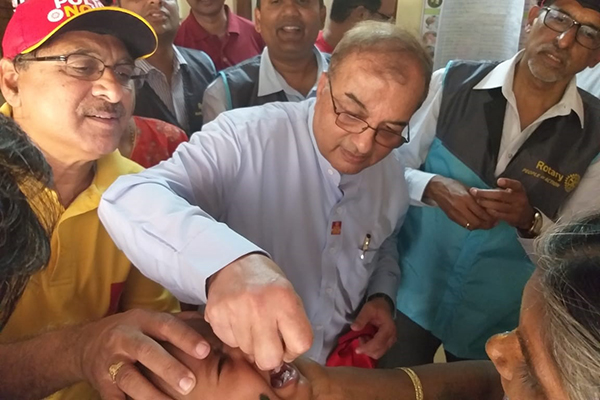
World Health Assembly declares polio eradication a public health emergency

This slideshow requires JavaScript.

By Stéphanie Tobler, RI Senior Media Relations Specialist Europe/Africa

Health ministers at the World Health Assembly in Geneva adopted a resolution on 25 May that declared “the completion of polio eradication to be a programmatic emergency for global public health.”

As a staff member in charge of public relations for Europe and Africa, I had the pleasure and honor of attending the briefing on the launch of the Global Polio Eradication Initiative’s emergency action plan at the Palais des Nations in Geneva, Switzerland, on 24 May. Rotary was represented by Past RI President Carl-Wilhelm Stenhammar. Continue reading

Wipe out polio, now

Ban Ki-moon

UN Secretary-General Ban Ki-moon immunizes a boy against polio during Angola’s first polio eradication campaign of the year. UN Photo/Quintiliano dos Santos

By Ban Ki-moon, Secretary-General of the United Nations

Wild viruses and wildfires have two things in common. If neglected, they can spread out of control. If handled properly, they can be stamped out for good. Today, the flame of polio is near extinction — but sparks in three countries threaten to ignite a global blaze. Now is the moment to act.

During the next two weeks, on two continents, two events offer the chance for a breakthrough. First, the leaders of the world’s largest economies, the G8, congregate at the U.S.presidential retreat at Camp David in rural Maryland. A week later, the world’s ministers of health convene in Geneva. Together, they can push to deliver on an epic promise: to liberate humankind from one of the world’s most deadly and debilitating diseases. Continue reading

Speaking of polio

Marty Helman

Marty Helman during a National Immunization Day in Africa last year.

By Marty Peak Helman, governor-elect of District 7780 and a member of the Rotary Club of Boothbay Harbor, Maine, USA.

I spoke about Polio Plus to a sell-out audience at my parents’ retirement home recently. There was not one member of the audience who didn’t have a personal story to share about polio – they all knew a time in America when every summer brought a new outbreak of the disease. And inevitably, they all remember a sibling or cousin or close friend who survived – or succumbed – to the disease. 

I told the residents that they had done their job too well. I told them that because of their enthusiastic support for the public health campaigns here in North America that followed rollout of first the Salk and then the Sabin vaccine, that young people today frequently think polio is a disease about as antiquated and as far from their consciousness as, for example, yellow fever or leprosy (both of which are also very much still threats in the developing world).   Continue reading

What was your favorite convention moment?

K.R. Raja Govindasamy

K.R. Raja Govindasamy, a former Rotary Foundation Ambassadorial Scholar, shares his favorite convention moment.

By Ryan Hyland, RI Editorial staff, reporting from Bangkok, Thailand

I caught up with a few Rotarians as they were getting ready to leave the 2012 RI Convention in Bangkok, Thailand, and asked what their favorite moments were.

Glen MacGillivray, a member of the Rotary Club of Petawawa, Ontario, Canada, said:

“The House of Friendship has been amazing. I’ve met an awful lot of people with shared interests and different interests. People who could help us with what we’re trying to do and us help them with what they want to do. We’re a small club. It was nice to be a part of something bigger. And hearing Muhammad Yunus was a great thrill. It’s a big reason why we came.” Continue reading

Using alumni network to promote End Polio Now

Enda Young

Rotary Peace Fellow Enda Young in front of a live Twitter stream at the Rotary World Peace Symposium.

By Enda Young, a Rotary Peace Fellow to Thailand, attending the Rotary World Peace Symposium

On day two of the Rotary World Peace Symposium, we (class 12) ran a workshop session looking at how peace fellows (over 650 worldwide) can assist with the Rotary “End Polio Now” Campaign. 

Polio has not yet been eradicated from Nigeria, Afghanistan or Pakistan and one the reasons for this is the difficulties caused by conflicts in certain areas in these countries.  One of the aims of the session was to see if we could start to utilitize the alumni network in these regions and beyond. Continue reading

Service projects, motorcycles, and Rotary

Karena Beirman

Karena Bierman races vintage motorcycles for a hobby.

By Karena Bierman, a member of the Rotary Club of Evanston Lighthouse, Illinois, USA, and manager of Gift Planning for The Rotary Foundation.

In 2005, a year after I started working at the Rotary Foundation, I worked on a tsunami relief project with a very active Rotarian – Chuck Remen, from the Rotary Club of Evanston Lighthouse.

He convinced me that I ought to be a Rotarian. (Actually, it didn’t take much convincing, because I liked the organization.) Since, I’ve been on the club’s board of directors every year. It’s not something I do because of my job. It’s something I do because my club is awesome. Continue reading

Why Congress’ support for polio eradication means so much to me

Diane WIlkins in an iron lung

Grant Wilkins' first wife, Diane, in an iron lung in the 1950s. Photo courtesy of Grant Wilkins.

By Grant Wilkins, past RI director and member of the Rotary Club of Denver, Colorado, USA.

In 1951, as a young father of three children ages 5, 2, and 3-months (the youngest born prematurely and still in the hospital), I contracted Bulbar Polio. 

My throat and vocal cords were paralyzed, and I couldn’t talk or swallow. A tracheotomy and intravenous feedings kept me alive for two weeks until the paralysis started letting up. 

My wife came to visit me for the first time after those two weeks, and mentioned she wasn’t feeling well. A spinal tap found she had the Lumbar Polio virus, and she was immediately admitted to the polio ward. Within 24 hours, she was completely paralyzed from the neck down and could not breathe on her own. Continue reading

Climbing Kilimanjaro to End Polio Now

Macon Dunnegan on Mount Kilimanjaro

Macon Dunnegan, a member of the Rotary Club of Charlotte-South, North Carolina, USA, at the summit of Mount Kilimanjaro.

By Macon Dunnagan Jr., a member of the Rotary Club of Charlotte-South, North Carolina, USA

In September, I will be leading a party of Rotarians from District 7680 (North Carolina, USA) up Mount Kilimanjaro in Africa, to raise money and awareness for Rotary’s End Polio Now campaign.

I am not a stranger to the top of the mountain. Since 1999, I have reached the summit 20 times, on my own and as an expedition director for Zara Tours, based in Moshi, Tanzania. Since my first wife, Michelle, died of ovarian cancer in 2007, I have been climbing Kilimanjaro every September in support of cancer awareness.

Last May, a friend of mine who is a Rotarian invited me to speak to the Charlotte-South Rotary Club about my climbing experience. They must have enjoyed the talk, for they invited me to join their club! Continue reading

Why a Rotary Youth Exchange 25 years ago still matters

Chrysula Winegar

Chrysula Winegar is community manager for the United Nations Foundation’s Million Moms Challenge and a former Rotary Youth Exchange student.

By Chrysula Winegar, a former Rotary Youth Exchange student to South Africa

When I was 17 years old, Rotary International gave me the opportunity to live in South Africa for 12 months.

My parents and brothers worked seven jobs to pay my way. That year changed everything about my life’s path and shaped my world view. It has impacted every major decision I’ve made since.

Many decades ago, Rotarians began creating these Rotary Youth Exchanges to foster global understanding and respect. A young girl or boy from an average family could spend a year in foreign lands, while in the safe arms of local families who created a framework for exploration.

I observed the last hurrahs of apartheid. We lived under a state of emergency with intense military presence including soldiers on our school buses carrying automatic weapons. Continue reading